
LILLEMOR MANNERHEIM
NATURE IN FORM
Organic, asymmetrical and often distinctly sculptural, Lillemor Mannerheim’s ceramics occupy an unusual position within post-war Scandinavian design. Her work ranged from tableware and vessels to animal sculpture, yet certain ideas recur throughout: an interest in irregular profiles, an understanding of objects in the round and, above all, a close observation of nature.
From Finland to Stockholm
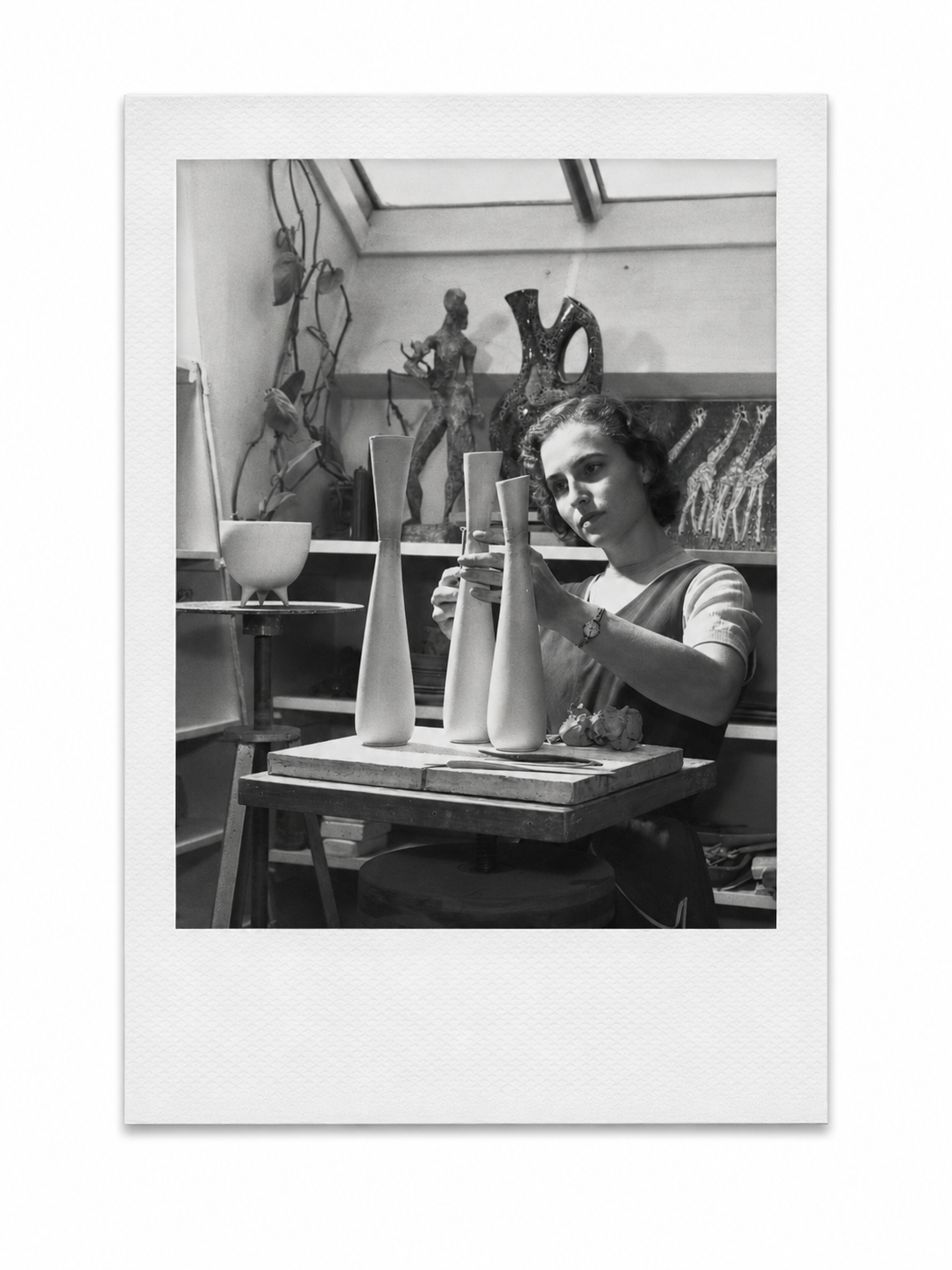
Ingeborg Aina Sophie Constance Mannerheim was born in Vichtis, Finland, in 1927 and spent her early childhood at Niemenkylä, the family farm some sixty kilometres from Helsinki. She drew the animals around her from an early age, particularly horses. They would remain a recurring subject throughout her life. The name Lillemor was given to her by her younger brother and was later adopted professionally.
Mannerheim moved to Stockholm in 1945 to study ceramics at Konstfack. During the summers of 1946 and 1947 she worked in the art department at Arabia in Helsinki, where she encountered artists including Birger Kaipiainen, who became a lifelong friend. After graduating in 1949, she joined Gefle Porslinsfabrik in Gävle, part of the Upsala-Ekeby group.
Paris and Sèvres
After a year at Gefle, Mannerheim left for Paris in 1950. At the Académie de la Grande Chaumière she studied sculpture under the Russian-French sculptor Ossip Zadkine, whose teaching focused on the human body and its transformation towards abstraction.
The following year she continued her training at the Manufacture nationale de Sèvres. Trial models were cast there from some of her designs. She returned to Gefle in 1952. Several models subsequently introduced by the factory originated in work she had undertaken at Sèvres. The years abroad also coincided with a shift in her work towards a more sculptural treatment of the ceramic vessel.
The “Moving Forms”
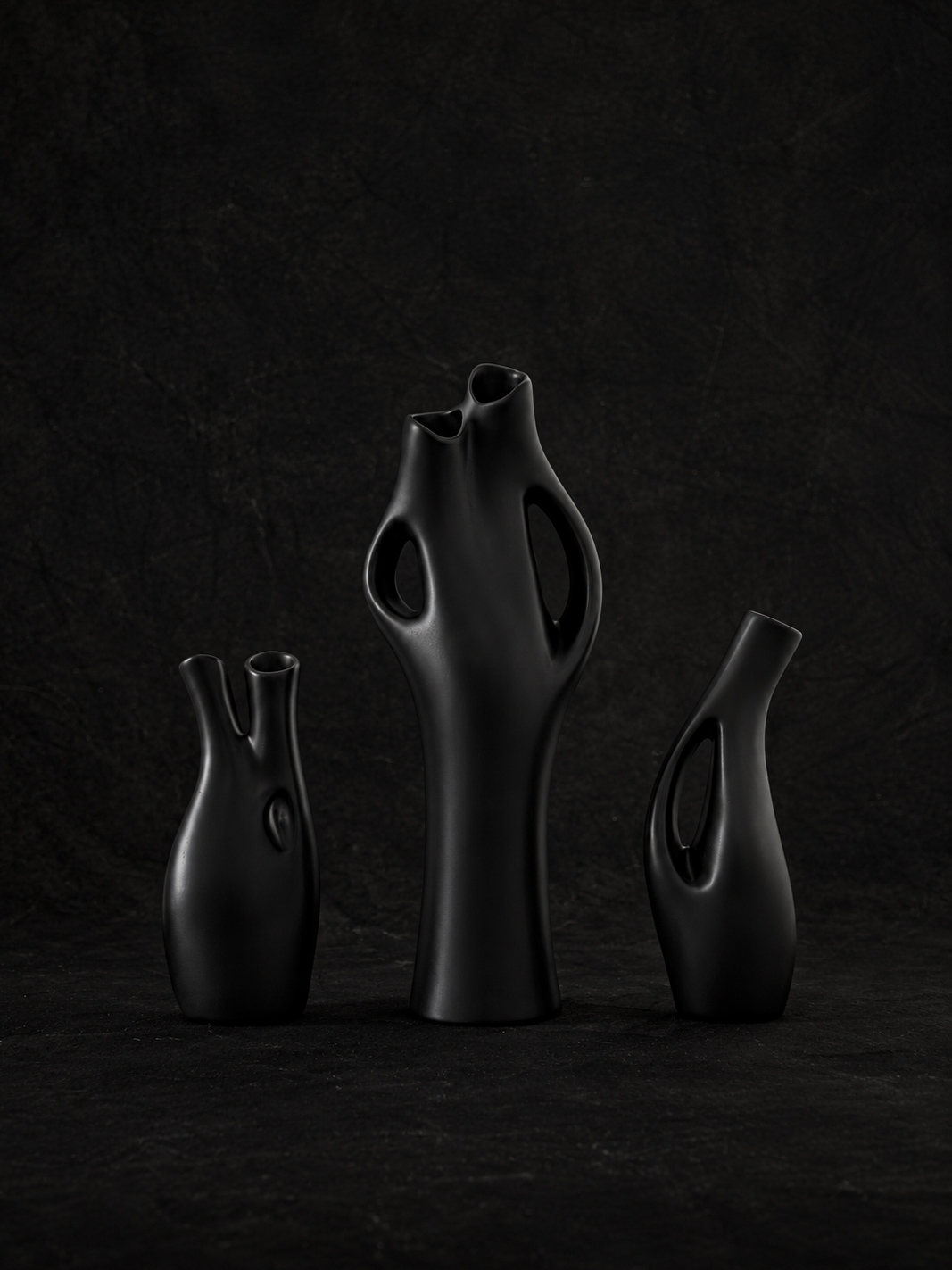
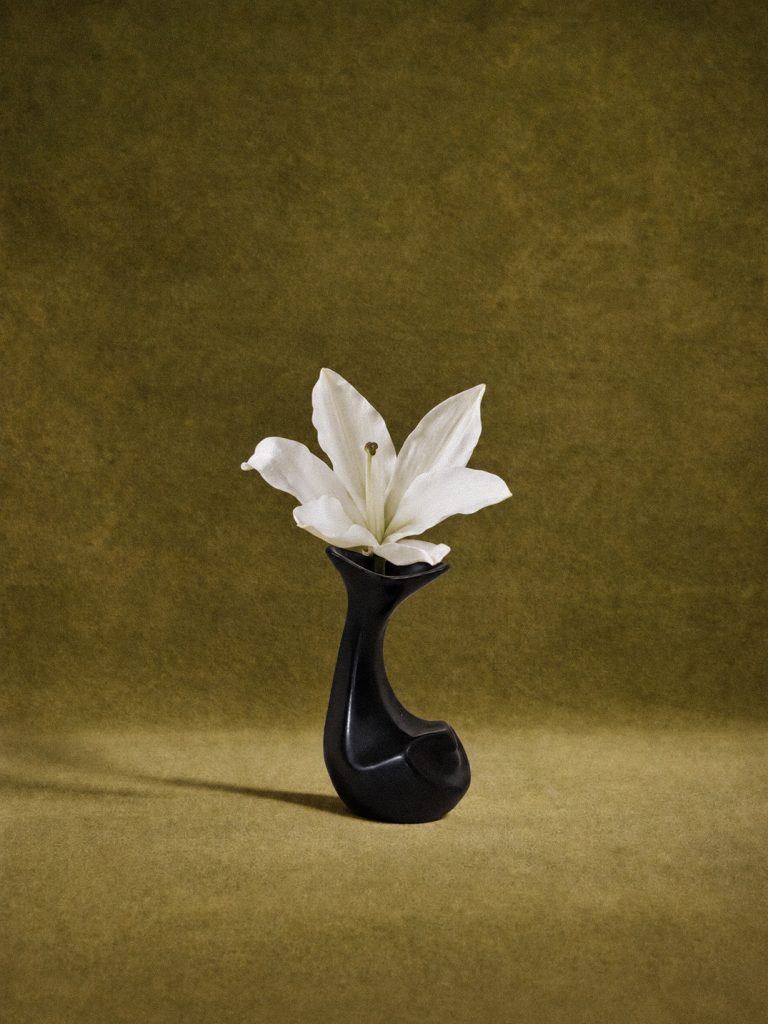
Between 1952 and 1957, Mannerheim produced some of her most characteristic work at Gefle. Alongside tableware patterns such as Solros and Västkust, she developed a very different group of objects: organic, lightly asymmetrical vases and bowls. These were the forms she described as rörliga — “moving forms”. The term is unusually precise. The movement is not literal, but comes from the changing profile of the object. A rim may rise on one side, an opening shift away from the centre — turn the vessel and its balance changes.
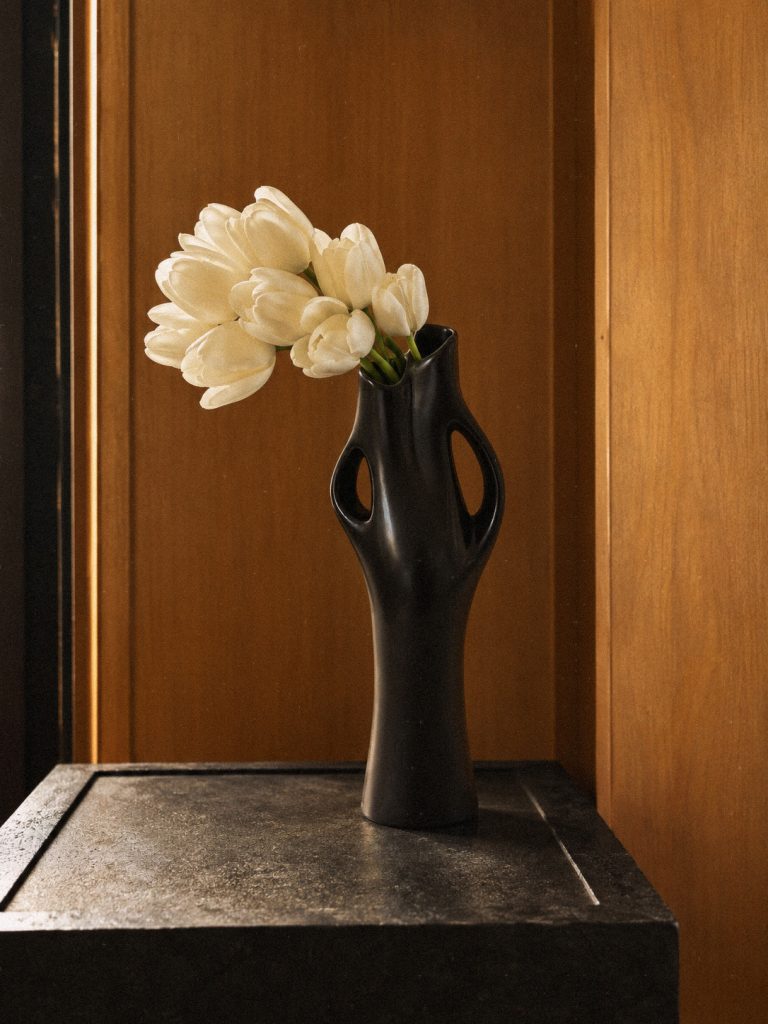
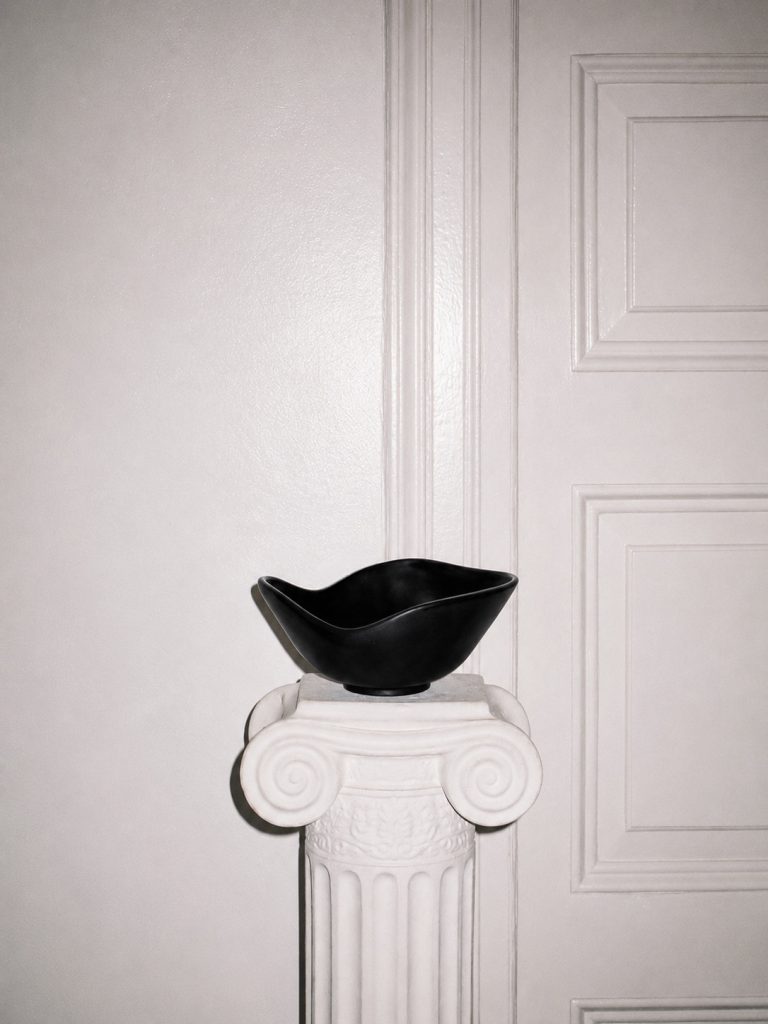
This approach can be seen particularly clearly in the M-Serie, introduced at Gefle in the mid-1950s, introduced at Gefle in the mid-1950s. Its bowls and vases are restrained objects, sometimes only slightly irregular. In others, the asymmetry determines the entire silhouette. Many examples were finished in Mangania, the black glaze developed at Gefle by factory engineer Arvid Nordbye. Other glazes and surface treatments were also used.
Mangania was particularly well suited to the series. On the darker examples there is little to distract from the shape itself; the eye follows the rim and the changing weight of the body below it. This was industrial production, but the best pieces do not look mechanically resolved. Small shifts in proportion give them the presence of modelled objects.
Mannerheim had returned from Paris and Sèvres with sculpture very much part of her training. In the M-Serie, that experience is visible in the way the vessel is treated as a volume to be viewed in the round.
From Vessels to Animals
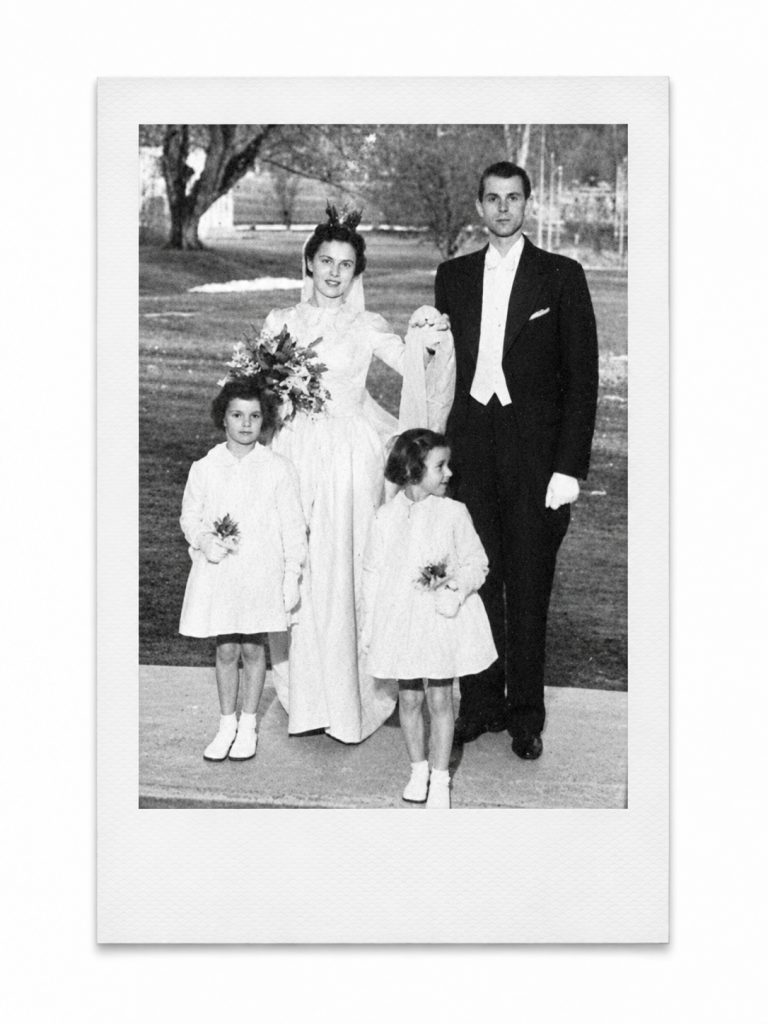
Mannerheim left Gefle in 1957 following her marriage to Carl-Gustaf Klingspor. The couple settled at Hellekis säteri on Kinnekulle in Västergötland, where she established a studio. She continued to work independently, with commissions for Hovmantorps glasbruk, Rörstrand and Nässjö Stolfabrik.
Animals became an increasingly important part of her work. Horses and birds appear repeatedly, alongside other species, ranging from closely observed studies to much simpler forms. There is a connection between these sculptures and the vessels Mannerheim had made at Gefle.
Both depend on silhouette and balance. Both are conceived as objects to be seen from more than one angle. For Mannerheim, animals were also familiar subjects. She had drawn them as a child at Niemenkylä and continued to return to them throughout her life.
Travel and Conservation
Mannerheim travelled widely in her later years, visiting Mexico and the Galápagos Islands, Kenya and Tanzania, Antarctica, Nepal and the Philippines. During a visit to Tibet in 1974 she met the 14th Dalai Lama. She later became involved with organisations concerned with Tibet and participated in the Tibet Committee’s work surrounding his visit to Sweden in 1988.
By the 1980s, her longstanding interest in animals had also become connected with conservation. In 1984, Mannerheim created De hotade (The Endangered) for Arabia, a series of sculptures depicting endangered animals, including pandas, penguins and koalas. They were sold in support of WWF. The project brought her back to Arabia almost forty years after she had first worked in its art department as a student.
The M-serie
Among Mannerheim’s ceramics, the M-Serie remains the clearest expression of her interest in the moving form. Its originality is quiet. There is no radical rejection of the vessel and little reliance on decoration. A bowl remains recognisably a bowl, a vase a vase. Instead, Mannerheim alters its balance: the position of an opening, the rise of a rim, the distribution of volume.
The objects are intended to be seen from different viewpoints. A profile that appears balanced from one direction may become markedly asymmetric from another. The M-Serie was produced at a time when Scandinavian factories gave designers considerable freedom to experiment with material and form.
Yet its strongest examples are difficult to reduce to period style alone. Their irregular profiles and shifting balance belong closely to Mannerheim’s own way of working.

A Different Kind of Symmetry
Mannerheim’s work is represented in Swedish museum collections, including Röhsska Museum in Gothenburg and Länsmuseet Gävleborg. The exhibition Rörliga Former and more recent scholarship have brought renewed attention to her work and her place in Scandinavian post-war ceramics.
Her best ceramics require little embellishment. Their character lies in proportion, surface and silhouette, and in a close observation of the irregularities found in the natural world. Not nature reproduced, but nature understood.
Explore Lillemor Mannerheim‘s designs at Artefact.
Sources and Further Reading
Jönsson, Love. “(Lillemor) Ingeborg Aina Sophie Constance Mannerheim.” Svenskt kvinnobiografiskt lexikon (SKBL), 2021.
Principal biographical source for Mannerheim’s childhood, studies at Konstfack, periods at Arabia, employment at Gefle Porslinsfabrik, studies under Ossip Zadkine, work at Sèvres, rörliga former, Solros and Västkust, Hellekis, later commissions and travels, her meeting with the Dalai Lama, De hotade and museum representation.
Langenskiöld, Susanne G. & Jönsson, Love (eds.). Handen och känslan: Lillemor Mannerheims liv och konstnärskap. Stockholm: Bokförlaget Max Ström, 2019.
Principal published monograph on Mannerheim’s life and work.
KWUM – Karin Widnäs Museum. Lillemor Mannerheim – Rörliga Former. Exhibition material.
Biographical and exhibition material relating to Mannerheim’s ceramic practice; documents De hotade as an Arabia series from 1984 and identifies subjects including pandas, penguins and koalas.
Röhsska Museum, Gothenburg. Museum collection records.
Works by Lillemor Mannerheim in the museum collection.
Länsmuseet Gävleborg, Gävle. Museum collection records.
Works by Lillemor Mannerheim in the museum collection.
Gefle / Upsala-Ekeby reference literature.
Documentation relating to Gefle production, the M-Serie and Mangania, the black glaze developed by factory engineer Arvid Nordbye.