
EDVIN OLLERS: ART AND INDUSTRY IN SWEDISH DESIGN
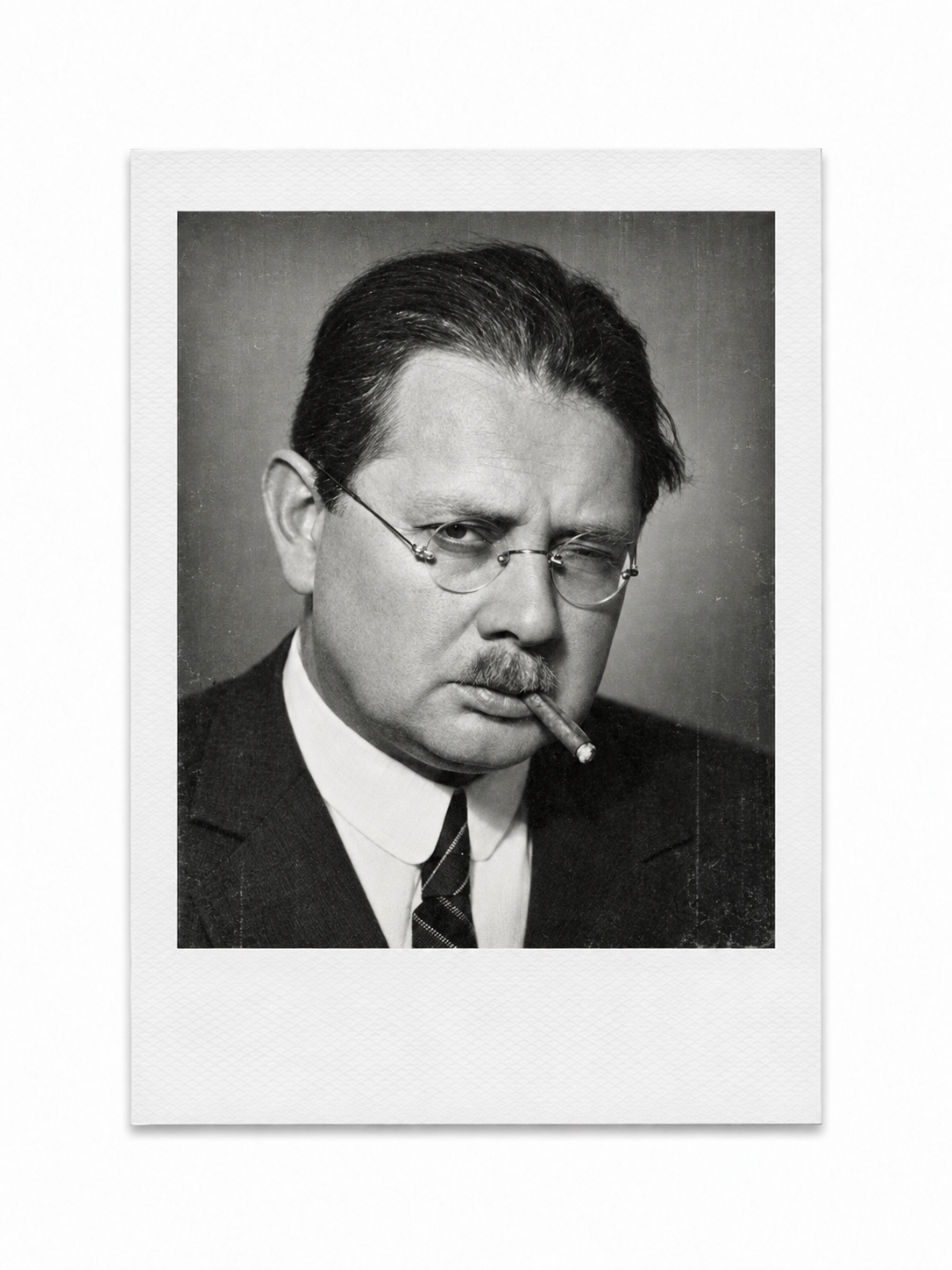
Edvin Ollers (1888–1959) belonged to a generation of Swedish artists for whom the distinction between fine and applied art was becoming increasingly fluid. Working in glass, ceramics, metalwork, painting and graphic design, he brought the sensibility of an artist to materials shaped by industrial production.
An Artist in Industry
Born Edvin Olsson in Norrtälje, Sweden, in 1888, Ollers was the son of a bookbinder. He studied at Högre konstindustriella skolan in Stockholm from 1906 to 1909 and continued his training at Göteborgs musei rit- och målarskola in 1909–10.
Ollers remained active as a painter and teacher throughout his life, but it was his engagement with Swedish manufacturers that came to define much of his professional career. He entered the field at a time when the relationship between artists and industry was being actively reconsidered.
The question was practical as much as aesthetic: could well-designed objects be made for ordinary homes, at prices ordinary people could afford? It was a question that would follow Ollers through much of his career.
Glass for a Modern Everyday Life
Ollers’s first important encounter with the glass industry came in connection with the 1917 Home Exhibition at Liljevalchs in Stockholm. The Swedish Society of Crafts and Design had encouraged artists to work directly with manufacturers as part of the campaign for vackrare vardagsvara — more beautiful everyday goods.
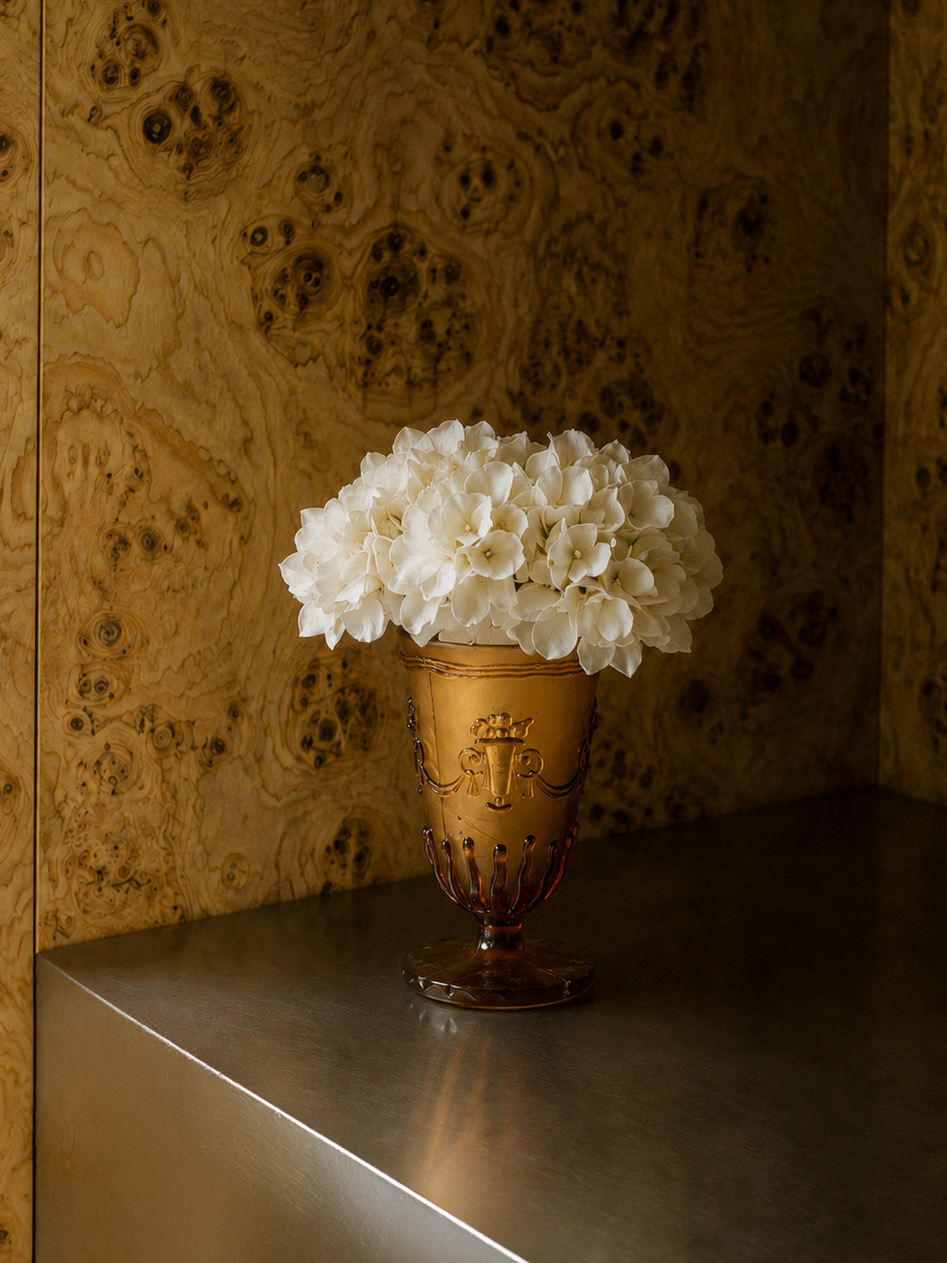
At Kosta, Ollers developed a collection of tableware that drew on historical European glass. Bowls, goblets and drinking vessels appeared in soft greens and blues, often with bubbles and irregularities left visible in the glass.
The pieces made for the 1917 exhibition were especially distinctive. Their uneven, bubbled surfaces had a rustic quality quite unlike the clarity and polish normally associated with fine crystal. Some of this character disappeared when the designs went into wider production and Kosta adopted a purer glass mixture.
Ollers’s work at Kosta was not limited to these rustic pieces. Surviving examples include footed vessels, flared bowls, moulded forms and more elaborate decorative glass alongside simpler tableware. Seen together, they reveal an artist testing what glass could look like when historical references, handcraft and industrial manufacture were brought together.
The collection gave Ollers an important place in the renewal of Swedish glass. It also put into practice one of the central ideas of the period: that artists should take an active role in shaping objects made for everyday life.
Across the Swedish Glassworks
Kosta was the beginning rather than the definition of Ollers’s work in glass. After his first period there in 1917–18, he moved between a succession of Swedish glassworks, including Reijmyre, Elme and Limmared, before returning to Kosta in the early 1930s. Later collaborations took him to Alsterfors, Åfors, Ekenäs and Flygsfors.
This movement between factories broadened both his technical range and his approach to form. Ollers worked with blown, moulded, cut and engraved glass, designing everything from drinking vessels and tableware to more sculptural objects. Rather than developing a single recognisable style, he repeatedly adapted his work to different materials, techniques and conditions of production.
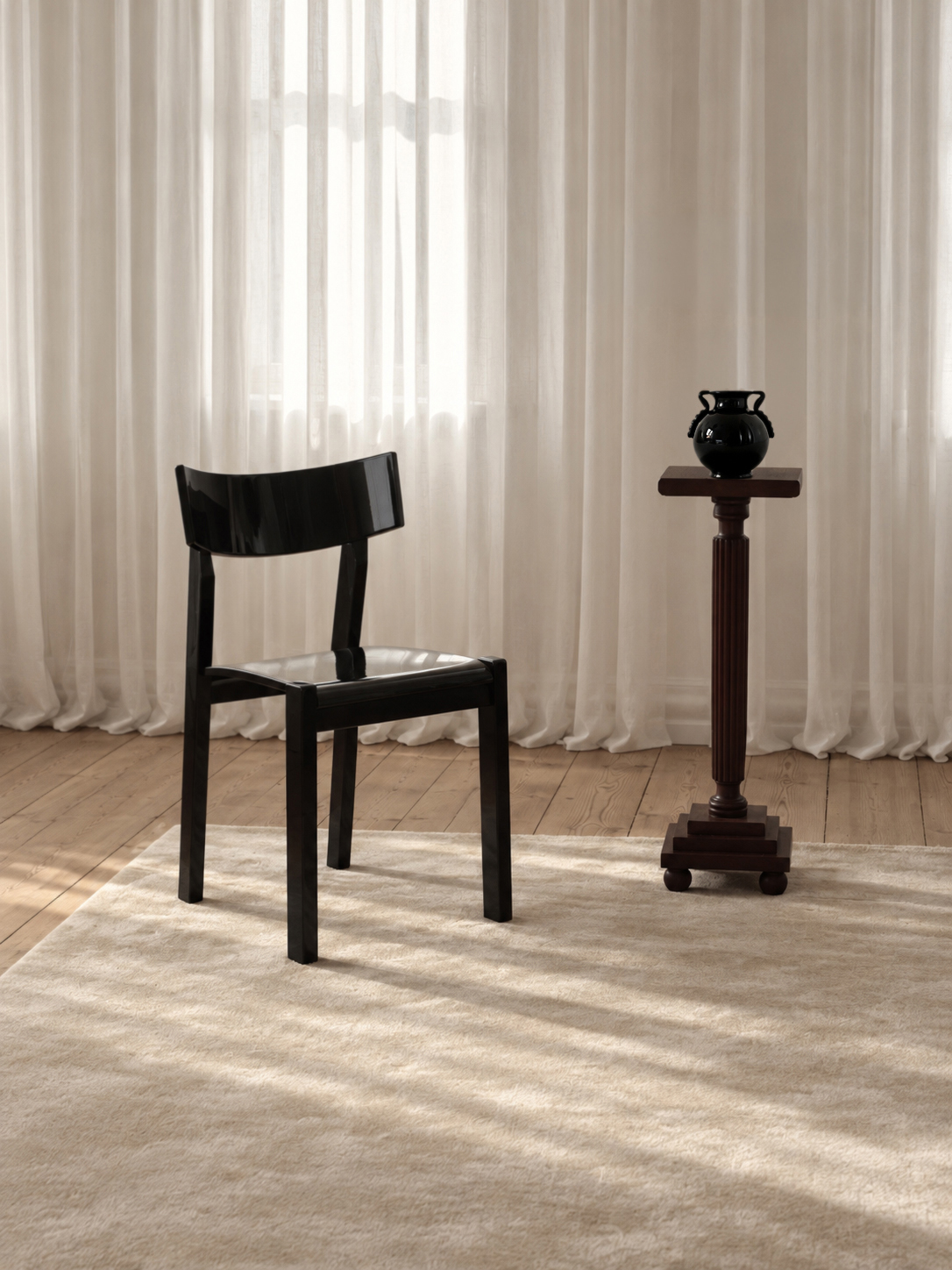
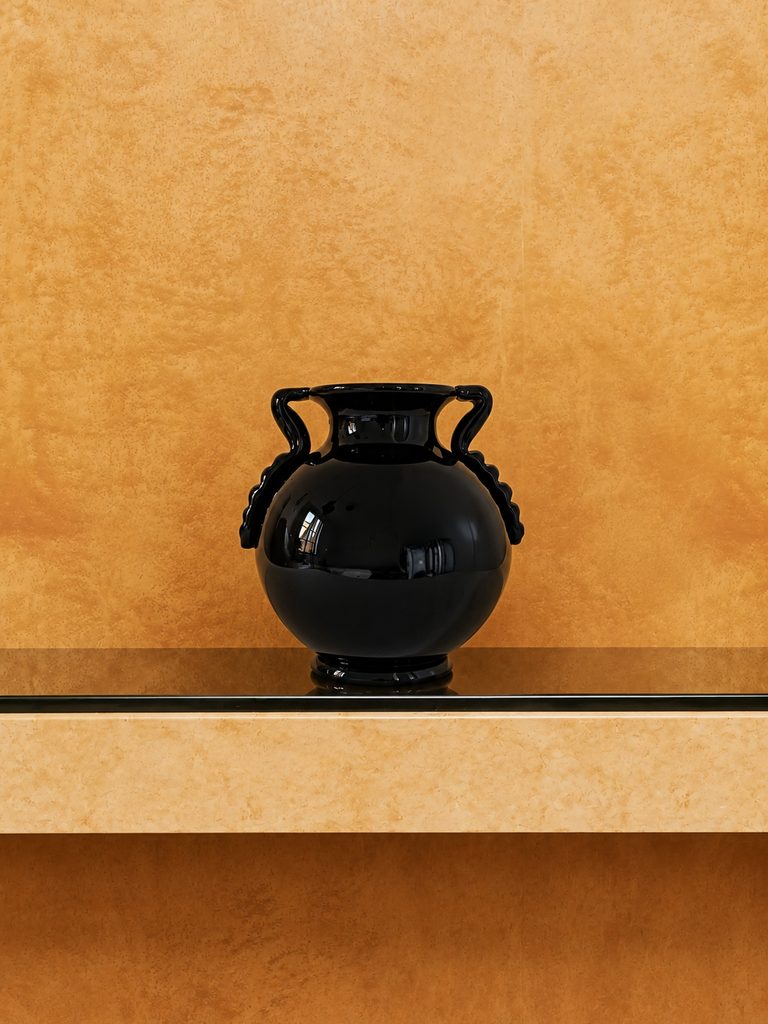
A striking vase associated with Ollers’s work for Engshyttan at Nybro illustrates this shift. Its almost spherical body, narrow neck and paired loop handles create a strongly symmetrical silhouette, while rows of applied glass along the sides introduce a decorative, almost architectural rhythm. The dark glass and controlled geometry place it firmly within the more stylised vocabulary of the interwar years, in marked contrast to the informal character of his early Kosta tableware.
From Glass to Pewter
Glass formed only one part of Ollers’s work. He was artistic adviser at Upsala-Ekeby in 1917–18 and later held similar roles at S Eriks Lervarufabriker, in 1921 and again in 1926–28. His activities also encompassed silver, nickel silver, book design, and other applied arts.
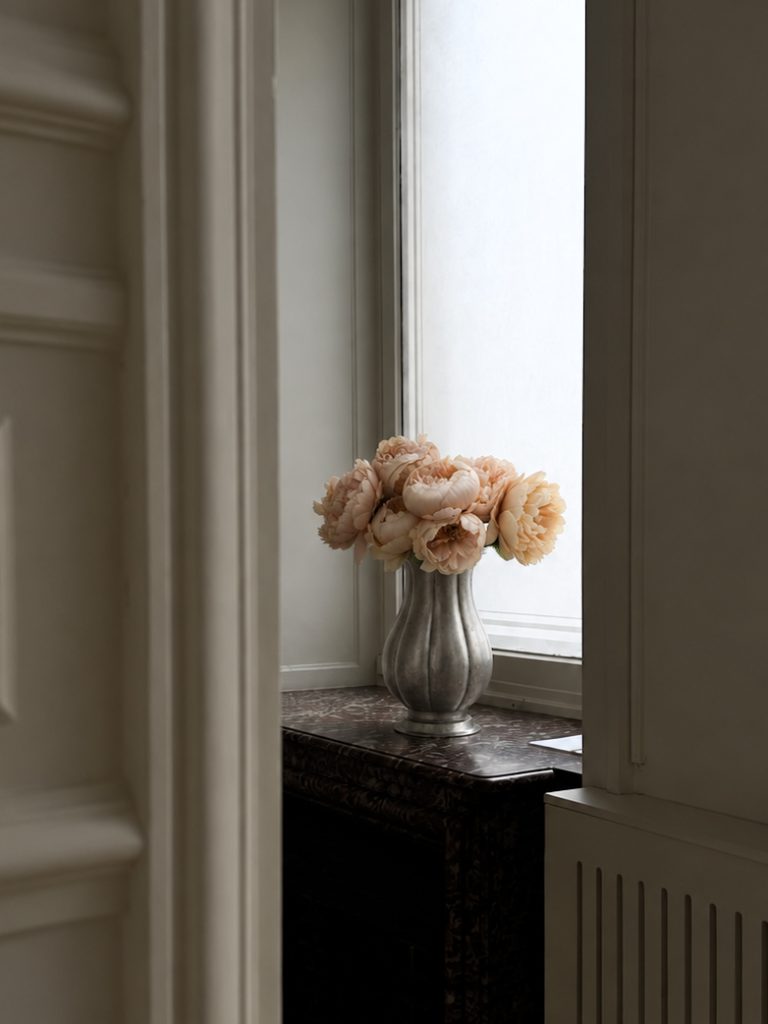
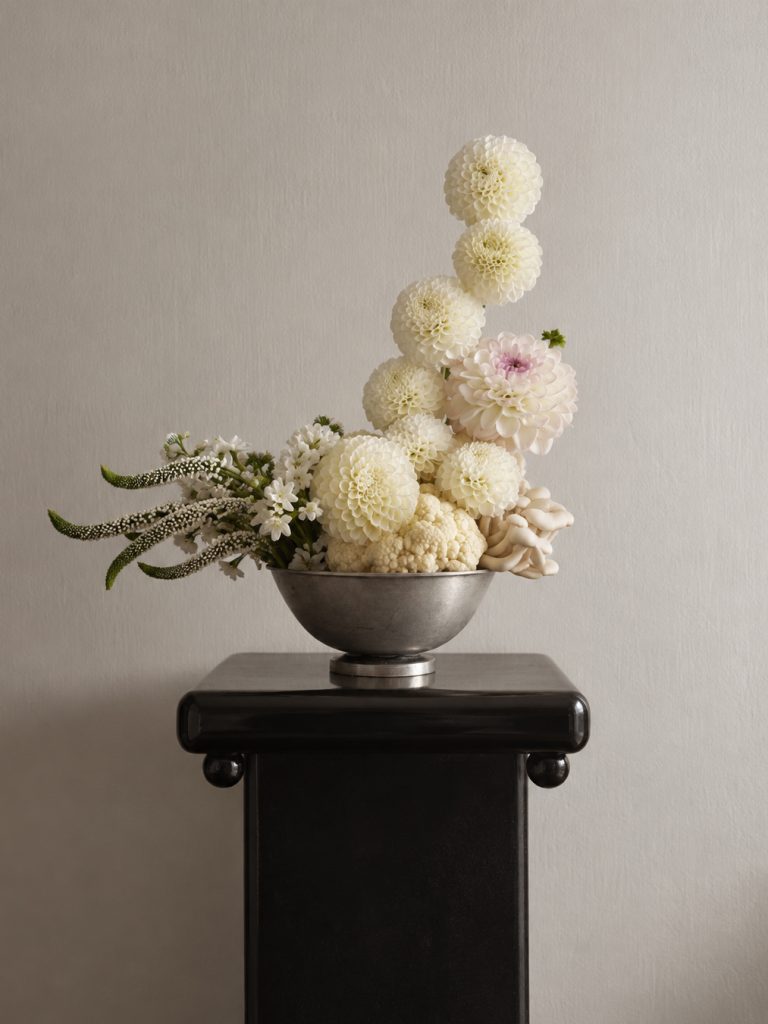
Metal became a particularly sustained part of his career through his association with the Stockholm firm Schreuder & Olsson. Beginning in 1924, Ollers designed pewter for the company until 1950, making it one of the longest collaborations of his professional life.
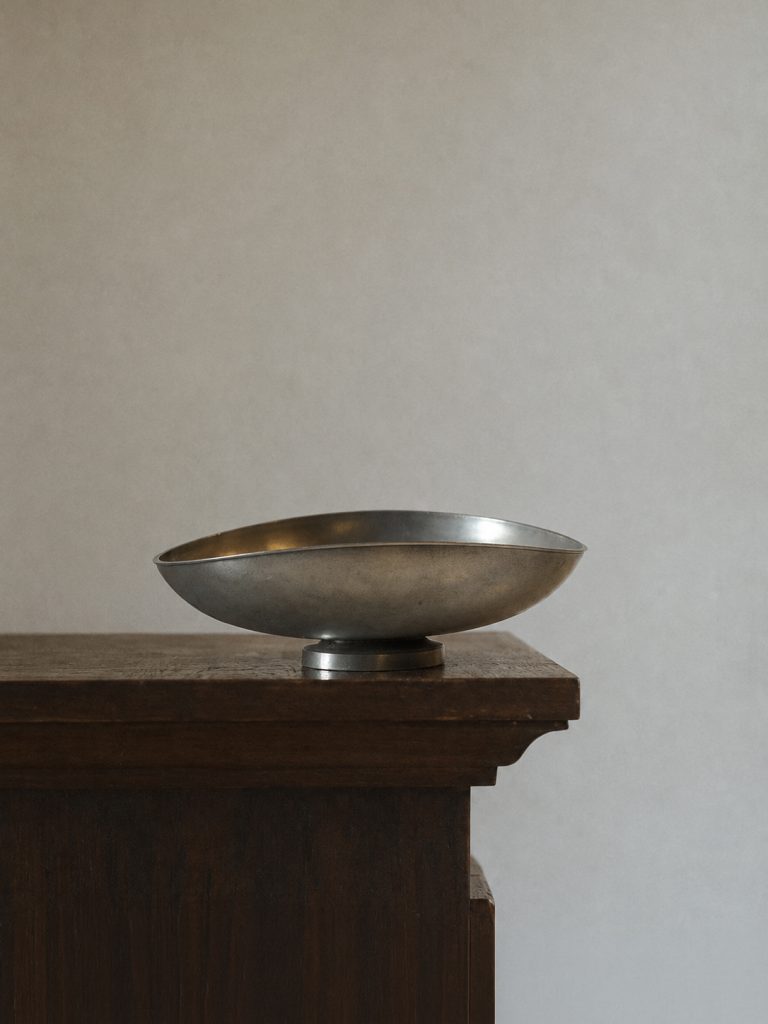
Bowls, vases, candlesticks and other domestic objects formed a substantial part of his work for the company. Many rely on remarkably little decoration. A shallow pewter bowl, raised on a compact circular foot, derives its presence almost entirely from proportion: the broad curve of the body set against the concentrated weight of the base.
Elsewhere, Ollers drew more explicitly on Baroque and other historical forms, simplifying and adapting them for contemporary use. These references became an important part of his work for Schreuder & Olsson and place his metalwork within the wider shifts taking place in Swedish design during the 1920s and 1930s.
Between Tradition and Modernism
During the 1920s, Swedish design became internationally associated with the refined classicism now described as Swedish Grace. By the end of the decade, functionalism had introduced a more radical conception of modern design, given its most public expression in Sweden at the Stockholm Exhibition of 1930.
Ollers cannot be placed neatly within either tendency. While his work retained an interest in historical forms, it also absorbed the simplification that increasingly characterised Swedish design between the wars.
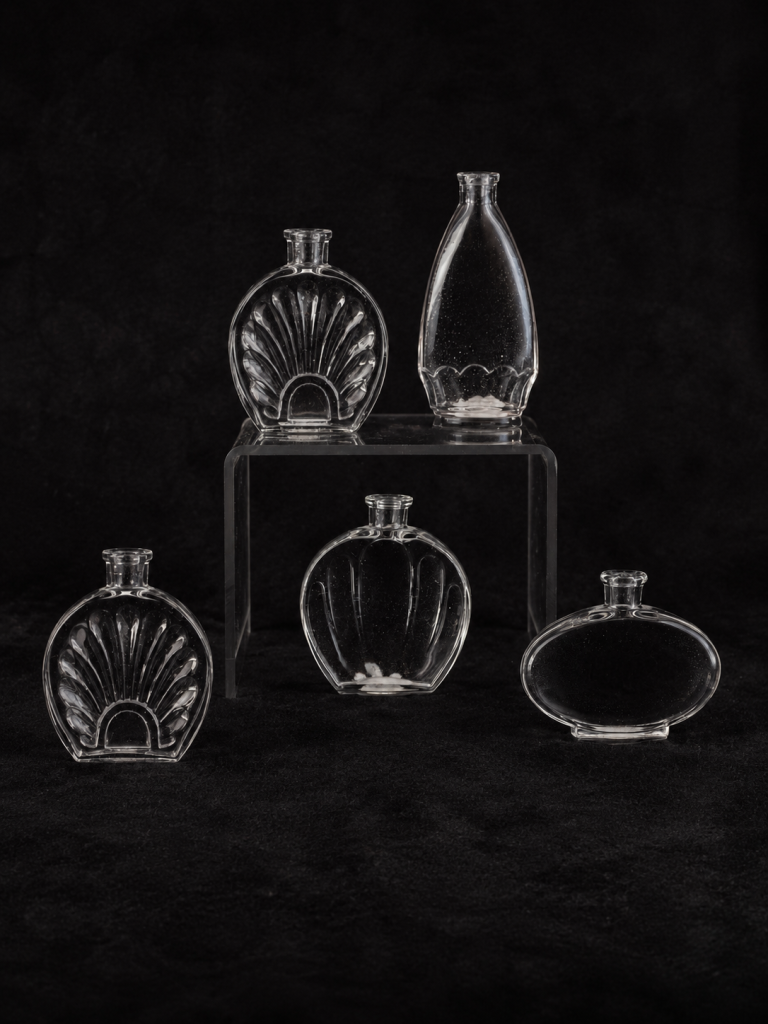
His designs for Limmared offer a particularly revealing example. Some of his bottles drew on older Chinese vessel forms, yet their simplified profiles and adaptation to industrial production gave them a distinctly contemporary character.
For Ollers, history was less a style to be preserved than a repertoire of forms available for reuse. Modernity could be achieved through reduction and reinterpretation as readily as through rejection.
Teaching a New Generation
Teaching was another constant in Ollers’s career. For decades he taught at Stockholm’s Tekniska skolan and its successor institutions, becoming a senior teacher in the 1930s and later teaching at Konstfackskolan in the late 1940s.
Among those who attended his lectures was Karin Björquist, who would become one of the defining figures of postwar Swedish ceramics. She recalled the breadth of his interests — from Japanese woodblock prints to African art — and, in particular, his insistence on drawing as a means of learning to see.
His importance therefore extends beyond the surviving objects that bear his name. Through both teaching and industry, Ollers participated in the institutions in which modern Swedish applied art took shape.
A Distinctive Position in Swedish Design
There is no single style that adequately defines Edvin Ollers. The coloured and deliberately irregular Kosta glass of 1917 appears at first to have little in common with the restraint of his later pewter. Across glass, ceramics, metalwork, books and painting, his work shifts between the rustic and the refined, the historical and the modern.
This breadth is fundamental to understanding him. Ollers was never identified exclusively with one factory, one material or one formal vocabulary. Instead, he moved repeatedly between them, responding to the particular possibilities of a material and the realities of its production.
Seen in this way, his career provides an unusually broad perspective on the transformation of Swedish design during the first half of the twentieth century. The ideals of vackrare vardagsvara, the classicism of the 1920s and the growing authority of industrial design all pass through his work, not as styles neatly adopted and abandoned, but as ideas continually tested through different materials and methods of making. His consistency lay not in a single recognisable style, but in an approach: allowing material, method and purpose to determine the character of the object.
Explore Edvin Ollers’s designs at Artefact.
Sources & Further Reading
Herlitz-Gezelius, Ann Marie. “Edvin Ollers.” Svenskt biografiskt lexikon, vol. 28. Stockholm: Svenskt biografiskt lexikon, 1992–1994.
Nationalmuseum. Edvin Ollers som konsthantverkare. Exhibition catalogue no. 256. Stockholm: Nationalmuseum, 1960.
Herlitz-Gezelius, Ann Marie. Vackra ting och bruksting från 10- och 20-tal. Stockholm, 1974.
Herlitz-Gezelius, Ann Marie. Kosta, glaset och konstnärerna. Stockholm, 1987.
Ricke, Helmut, and Ulrich Gronert. Glas in Schweden 1915–1960. Munich: Prestel, 1986.
Wettergren, Erik. “Kostaglaset 1917–1942.” In Kosta glasbruk 1742–1942. Kosta, 1942.
Nationalmuseum, Stockholm. Collection records for works by Edvin Ollers, including glass from Kosta and pewter produced by Schreuder & Olsson.
Kulturparken Småland / Smålands museum. Collection records for glass designed by Edvin Ollers.
Ericsson, Anne-Marie. Svenskt 1920-tal: Konsthantverk och konstindustri. Stockholm, 1984.
Widman, Dag. “Konsthantverk, konstindustri, design 1895–1975.” In Konsten i Sverige. Stockholm, 1975.
Nisbeth, Åke, and Tage Fogelberg. Reijmyre glasbruk. Stockholm, 1960.
Dahlbäck Lutteman, Helena. Svensk 1900-talskeramik. Stockholm, 1985.
Wollin, Nils G. Från ritskola till konstfackskola: Konstindustriell undervisning under ett sekel. Stockholm, 1951.
Limmared: Bygden, bruket, samhället 1740–1990. Limmared, 1990.