
MONA JOHANSSON: OBSERVING THE POETICS OF URBAN LIFE
Mona Johansson (1924–2010) holds a quietly significant place in 20th-century Swedish art, recognized for her perceptive renderings of urban and domestic spaces. Her lithographs and drawings trace streets, interiors, and objects with precision, capturing fleeting moments suspended between memory and transformation.
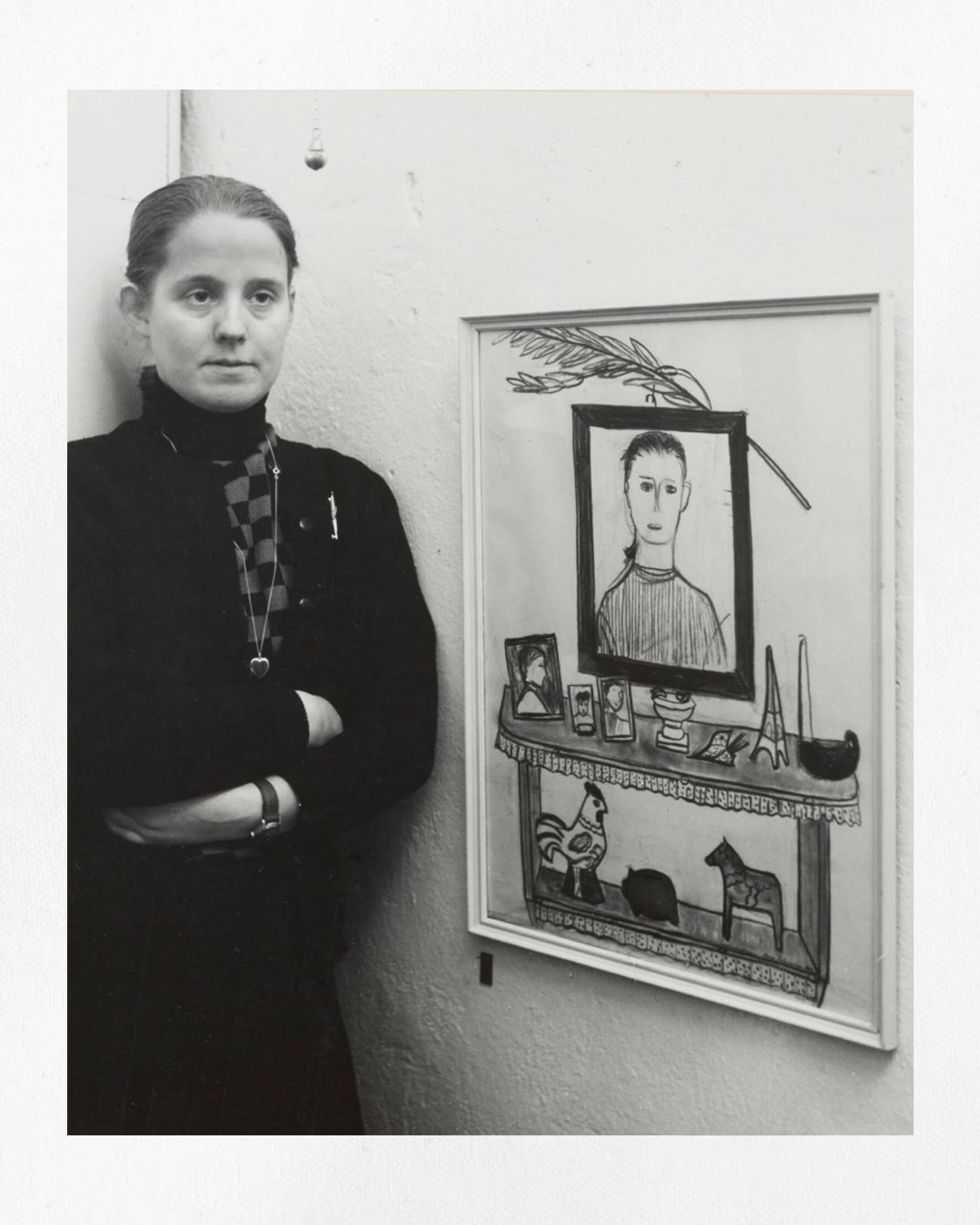
Mona Johansson in 1954 at Lilla Paviljongen, Stockholm
From Commerce to Creation
Born in 1924 in Masthuggs parish, Gothenburg, Mona Johansson followed an unexpected path to art. The daughter of Eric Johansson, a head of operations, and Britta Maria Hissing, she began in business studies before redirecting her life toward the visual arts. From 1946 to 1949, she trained at Hovedskous målarskola in Gothenburg, mastering the disciplines of drawing, composition, and printmaking. Encounters with European art deepened her perspective: museum visits in Paris and journeys through France and Italy exposed her to a breadth of traditions. Yet, amid this cosmopolitan dialogue, Mona Johansson preserved a distinctly Nordic sensibility—marked by clarity, restraint, and an unyielding attention to form—that would become the hallmark of her mature work, shaping a career devoted to the poetics of observation and memory.
Naïvistic Precision
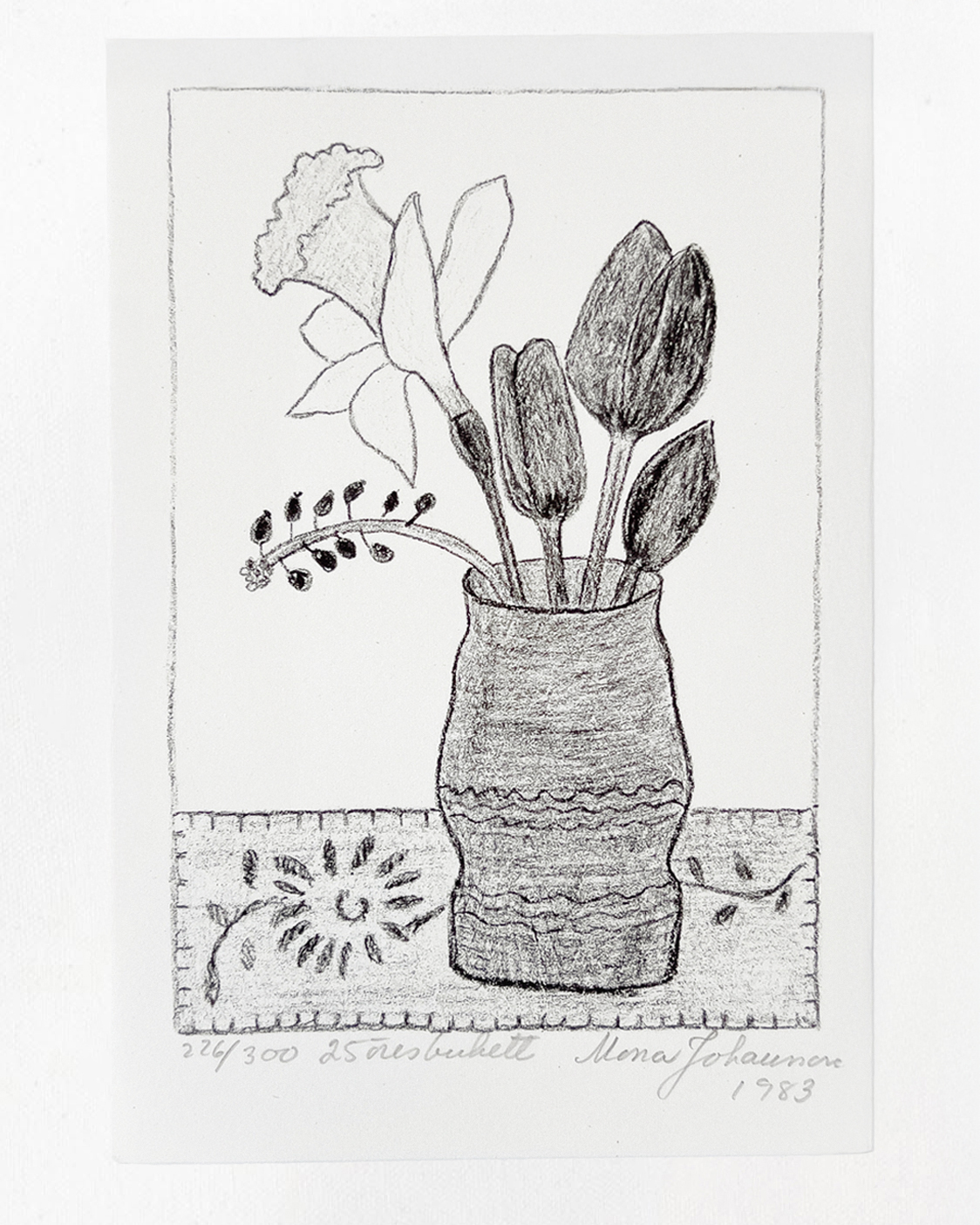
Mona Johansson’s work is often described as naïvistic—a conscious stylistic strategy rather than simple naïveté. Her lithographs and drawings distill the urban and domestic landscape into compositions of clarity and precision, where architectural forms, narrow streets, and interiors are rendered with geometric rigor and unadorned surfaces. While human figures are rarely depicted, their presence resonates through subtle traces: a slightly open door, a fluttering sheet of laundry, the long shadow of a window sill. Mona Johansson’s approach marries this formal exactitude with intimate, playful observations of domestic life—arranged objects, table settings, and stuffed animals—creating a quiet tension between the public and private spheres. Her visual language reflects a disciplined economy of line and form, producing works that are simultaneously documentary, poetic, and deeply attuned to the rhythms of everyday experience.

Gothenburg in Transition
Gothenburg remained both Mona Johansson’s birthplace and her enduring muse. She closely observed neighborhoods such as Haga and Majorna as they underwent profound transformation, when historic buildings and narrow streets were increasingly replaced by modernist redevelopment. Rather than romanticizing the past, her work functions as meticulous visual testimony: through her lithographs and drawings, Mona Johansson articulated a city in flux, preserving the visual memory of spaces that risked erasure. Exhibitions such as the December shows at Gothenburg’s Konsthall and Unga tecknare at Nationalmuseum in 1954 situated her within a generation of artists attentive to the interplay between architectural form and lived experience, documenting the tension between continuity and change in the urban landscape she so intimately knew.
An Enduring Presence
From early solo exhibitions at Folkets hus in Gothenburg and Lilla Paviljongen in Stockholm in 1954, to participation in the Bradford Biennale in 1970 and 1972, Mona Johansson’s reach extended beyond Sweden. Her works now reside in the collections of Moderna Museet, Nationalmuseum, Göteborgs konstmuseum, Borås konstmuseum, and Hallands kulturhistoriska museum. Although Mona Johansson passed away in 2010, her serene lithographs endure as cultural documents—unfolding the story of a city, a time, and an artist who chose to see with clarity and to remember with care.
Discover Mona Johansson’s art at Artefact.